Building The Future
Tradesman Place: ‘The key is matching teens with jobs that likely meet their interest and skills’
CRAIG GARRETT - Daily Sun Correspondent
ENGLEWOOD — Like many Florida teens, Antonio Carrillo was unsure of his future.
The military and college were off the menu, he said, before career specialists at Lemon Bay High School paired him with Brian Phillips, the founder of Tradesman Place.
“He helped me out with life,” Carrillo said of acceptance into the program last August.
He finishes in May and will be immediately employable.
Phillips, who runs Phillips Landscape Contractors in Englewood, started his nonprofit after years of new hires failing — even with a comprehensive screening, he added.
It wasn’t uncommon for a worker to quit after a few hours, he said, in part because the prospect wasn’t emotionally prepared.
“I’d find them walking down the street,” he said of new hires. “They weren’t prepared. (You) don’t want to throw them out there, they get disengaged.”
So after years of frustration and building his business, Phillips acted on an idea to better prepare young workers for a job, a sort of boot camp, without the “drop and give me 10” thinking.
He first ran volunteers from his staff through the program, tweaked things, then in August started with four teens recruited from Lemon Bay and Imagine School at North Port. Guidance and career counselors had selected kids that weren’t on college tracks and who showed skills beyond books, he said.
The key is matching teens with jobs that likely meet their interest and skills, combines work training with 11 “cans” or platforms, a deep dive at skills Phillips decided best suit young people entering the workforce.
The other key is recruiting employers willing to accept the responsibilities, and pay for more than $20 per hour, in return for a seasoned kid immersed in the work concept, Phillips said.
Aside from his own firm, Phillips had recruited a local construction company. But he pictured an array of businesses hopping on the bandwagon as things unfolded, in health, retail, construction, even sales, or a “paid opportunity to digest” a host of jobs, Phillips said of young recruits.
“It’s a whole new ecosystem that will revolutionize” young workers and their futures, he said.
More importantly, he added, absorbing life skills early directs young workers to “find their way, to elevate the excitement. And they find value in themselves.”
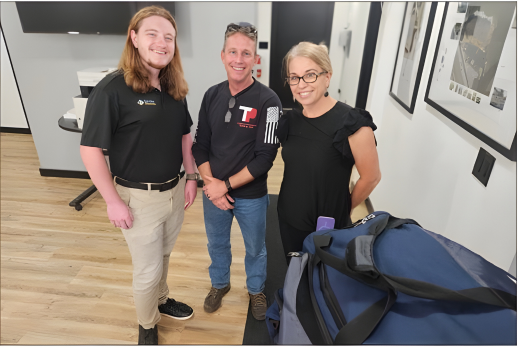
The idea also is keeping non-college-bound kids in Southwest Florida, or “developing a community, kids taking ownership,” he added.
Four teens enrolled in the Tradesman Place program on a recent day spent three hours on CPR training, for instance, which was hosted by Breathe Florida, a nonprofit started by Andrew Emerton, himself saved by a friend trained in CPR, or cardiopulmonary resuscitation. The recruits attend classes Monday-Friday, three hours per session.
Wild noises outside the classroom were the students pressing on a CPR manikin, in cadence, elbows locked, pumping and blowing air into the lungs, getting involved the very physical act of saving of a life. Drowning and other topics were covered.
They seemed intensely involved — and having fun doing it as a team.
Students in the program are paid an hourly wage by host employers, who also pay additional fees to Tradesman Place for the program that will run concurrently with school.
Phillips stripped and refurbished a building to host the program.
Phillips is also creating a platform for Tradesman kids to build an electronic resume, complete with every accomplishment, badge and certificate achieved. Potential employers would access the platform, see a candidate with advanced life skills and an stronger ability to absorb new information, he said.
“Life is easy,” he said, “if you keep doing the right thing.”
For more information, visit tradesmanplace.com